
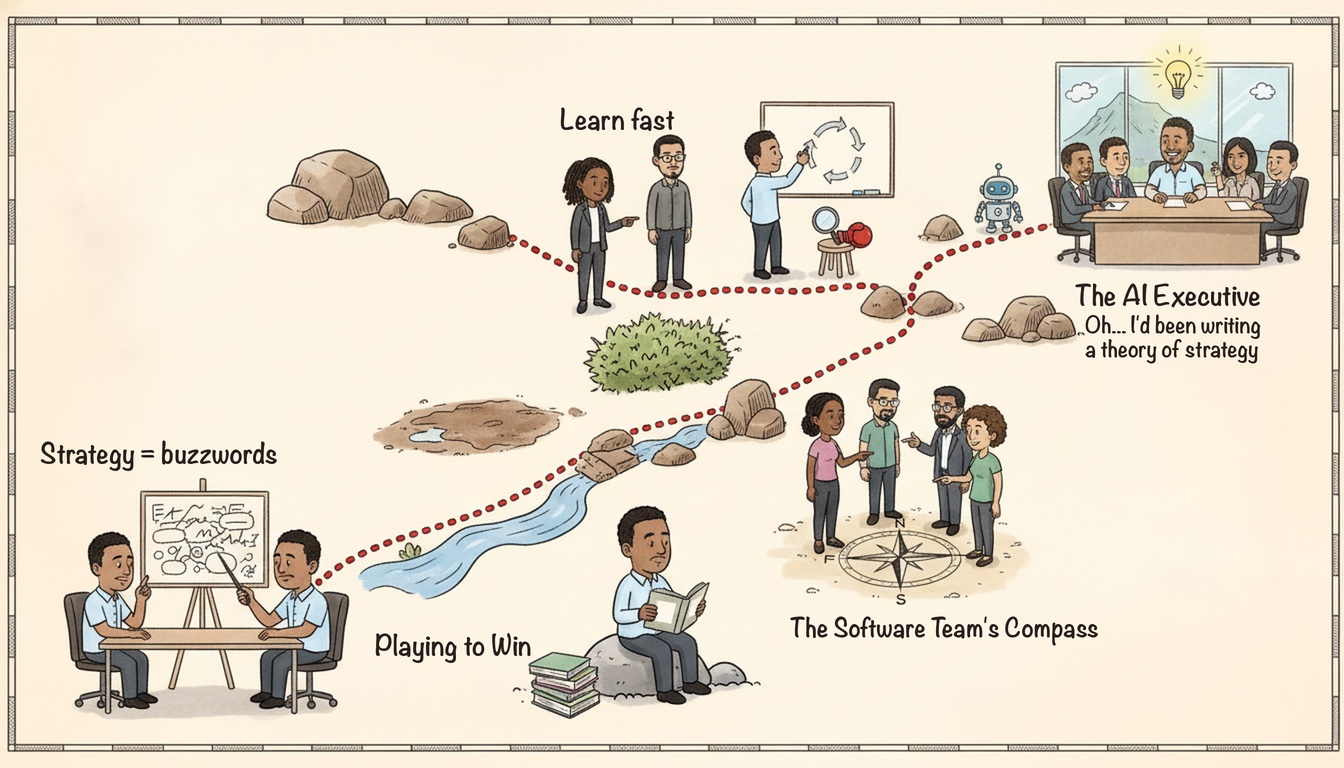

I'm deep in my third position paper for my EMBA at the UCT Graduate School of Business, and the brief asks me to build my own theory of strategy. My honest first reaction: where do I even start? I build technology. Strategy, I thought, was something that happened in other rooms.
Then something odd happened. Every time I tried to work out where I stood on something, I found myself back here, scrolling through my own blog. On the third or fourth visit, the penny dropped. I thought I'd been writing about technology. Fixing technology problems, reviewing books. But post after post, I'd been building a theory of strategy. I just never called it that. Unconscious competence, in the textbook sense: doing the thing without knowing you're doing it.
In short, that theory says strategy isn't a boardroom ritual but a skill for everyone who builds, and that you get better at it by testing your choices and learning fast. None of it is AI-specific: it's how I approach business strategy in general, and how I build ordinary software too. I apply it most to AI right now, because AI is the biggest shift I've seen in my career: it's changing how software gets built and how businesses run, faster than any plan can keep up with, and that's exactly the kind of ground this way of working was made for. It came together in pieces, post by post, and this is the trail.
In mid-2025 I was a portfolio manager, still carrying the frustration of my senior engineer years: sitting in strategy sessions and walking out with nothing I could actually act on. My review of Playing to Win is where it started. What I liked about the choice cascade was that it hands autonomy down as it flows, and that it treats choices as things to test. Even then I wrote that in fast-moving tech you have to plan as you build.
A few weeks later I wrote what turned out to be my fullest early version: The Software Team's Compass. Strategy as a way of being, in 3 parts. A choice cascade you synthesise by actually listening to leaders and engineers. Values as social contracts, where what we say and what we do can quietly drift apart. Goals as signals, not targets. It ended with a line I still live by: planning is important, the plan isn't.
Reading it back, most of the theory was already there. What it lacked was scope. It was a theory for a software team.
The book reviews tell the same story from another angle. The Lean Startup taught me to get out early, shipping fast to test assumptions rather than building in isolation, and Hacking Growth broke down the wall between marketing and engineering, showing me that growth is a habit you can engineer, not magic, as long as you stay suspicious of vanity metrics. Measure What Matters gave me OKRs as the link between engineering work and business strategy, set together rather than handed down. Marty Cagan's series, with Transformed the one that pulls it all together and sits at the core of how I work, gave me empowered teams solving problems instead of shipping features, discovery before delivery, and every idea tested against 4 risks before you bet on it: is it valuable, is it usable, can we build it, and does it work for the business. Team Topologies showed me that your systems end up copying how your teams communicate, so how you shape teams decides how fast they can flow. Pattern Breakers taught me to watch for inflection points, the big external shifts you want to spot before anyone else does. And from Kahneman and Adam Grant I took the discipline of thinking like a scientist: look for the evidence that you might be wrong, build a challenge network, and disagree about ideas while protecting the relationships. Put together, the reviews show what I look for in a book about strategy: ways to learn fast in the open, and ways to guard against my own certainty.
Then there are the AI books, and they matter because a strategy for AI is only as good as your grasp of what AI actually is. Writing code with it every day teaches you what it can do; it doesn't teach you where it came from, what intelligence even means, or what it does to the people whose work it changes. 3 books filled those gaps. Superagency by Reid Hoffman and Greg Beato pulled me past the technology into the socio-economic and ethical questions, and its split of zoomers, doomers and gloomers gave me words for where people stand. Max Tegmark's Life 3.0 unpacked what intelligence actually means, with a physicist's grounding in the science. And Pedro Uria-Recio's How AI Will Shape Our Future reminded me how long AI has been around, longer than even I'd assumed. Together they keep my AI strategy grounded in people, ethics and history, not just in the latest model.
The 2026 writing is different. In August I started a series on commercialising AI, The AI Executive and the 4 parts after it. The subject had grown up. The unease about AI had turned into an operating playbook. A fixed blueprint was impossible because the ground kept shifting. Leaders had to give air cover and absorb friction. Governance had to judge working systems, not hypothetical fears. And you measure adoption, then behaviour, then value, in that order.
Looking back over the whole trail, the seeds were there from the start: emergence, listening, holding choices loosely, watching for the signals that tell you to change. What changed is everything around them. The altitude went from leading engineers to sitting at the executive table. And the biggest shift of all: I finally started calling what I do strategy instead of delivery.
There was one more piece. The brief also asked for a metaphor: one image that captures how I approach strategy. I tried a few before landing on the one I've actually lived, overlanding. On the Namakwa Echo Trail we planned for 6 months and the terrain ignored almost all of it. What kept us going the right way wasn't the plan, it was the Orange River: as long as it was on our right, we were heading west. That's strategy as I practise it. Hold the heading firmly, find the route on the ground, and bring the whole convoy with you. Picturing it that way pulled all these scattered posts into one model. The full map, the trailer full of legacy and the Ranger that hauls it are a story for the paper.
I didn't set out to write a theory of strategy. Turns out I'd been writing one all along, one post at a time. Now comes the fun part: finding out whether it holds up.