


The Prep & The Stage
There is a specific kind of magic that only happens when you strip away the insulation. Most travelers experience the world through climate-controlled cabins and predetermined flight paths, effectively keeping the landscape at arm’s length. Overlanding is the antithesis of that. It is an "exposed" way of moving—where you feel the high-frequency vibrations of the Karoo in your spine, the talcum dust of the trail in your contact lens boxes, and the legitimate, physical hurt of damaging your own iron. This is the price of admission to the last wild places in Southern Africa.
After six months of meticulous tactical planning, our goal was an ambitious 5,000km loop. Starting from Cape Town, we aimed to snake along the life-giving Orange River, navigate the rugged Namakwa Echo Trail, and push deep into the uncompromising desert of Namibia.
We weren’t looking for the soft route. Our ethos was simple: we did not come all this way to avoid minor obstacles like mountains, rivers, or deserts. We came to meet them head-on. To prove the point, we chose to kick off with the most notorious stretch of dirt in South Africa: the R355.
The Gear & Teams

Our expedition kicked off just as the Dakar was screaming across the Saudi sands, and the timing wasn’t the only thing we shared with the legends. Here team work and comradery also play a part. While Sergio and I have been overlanding for a long while, this was the first time we had a multi-car team for a serious trek. Having that second pair of eyes for spotting lines and the absolute safety net of a recovery partner changed the nature of the drive from "survival" to "exploration."
I took my 2024 NextGen Ranger 2.0L SiT XLT, a baseline mission to find the limit of the stock platform before deciding on an upgrade path, while towing a rental Metalian Genie as a try-before-you-buy exercise. In the Co-pilot seat I had my dad Nolan and mother Michelle. Sergio piloted the "Battle Tank"—a 2016 3.2L T6 Ranger—a study in overlanding excess with raised suspension, full bar work, dual battery system, roof racks, and a Conqueror trailer. Co-piloted by he’s dad Leon and wife Karen, with pit crew kids Scott and Cruise.
The Journey Begins: The R355
We rolled out of Cape Town mostly on schedule, despite the inevitable departure setbacks that plague any major expedition. There was no gentle introduction; the R355 is a rite of passage—250km of tire-shredding shale and relentless, high-frequency corrugations.
On this road, tire pressure is everything—1.8 bar at most. Sergio found the rhythm punishing in the T6; its stiff suspension fought the road, and by the time we hit Calvinia, the vibrations had already claimed their first victims, rendering parts of our gear into scrap metal. In contrast, the NextGen’s refined damping soaked up the chatter with surprising poise.
By Calvinia, we were exhausted. We searched for a tar bypass to Pofadder just to give our skeletons a break, but the maps were lying. "Smooth gravel" quickly dissolved into ruts more aggressive than anything we’d seen. But the Karoo gives as much as it takes. Just as our spirits flagged, the sky ignited—a deep, burnt orange sunset bleeding across the plains. We finally rolled into Pofadder at 10:00 PM, pitching camp in the dark and celebrating a day that had gone gloriously "off-script" with a 15-year-old whiskey.
Into The Namakwa
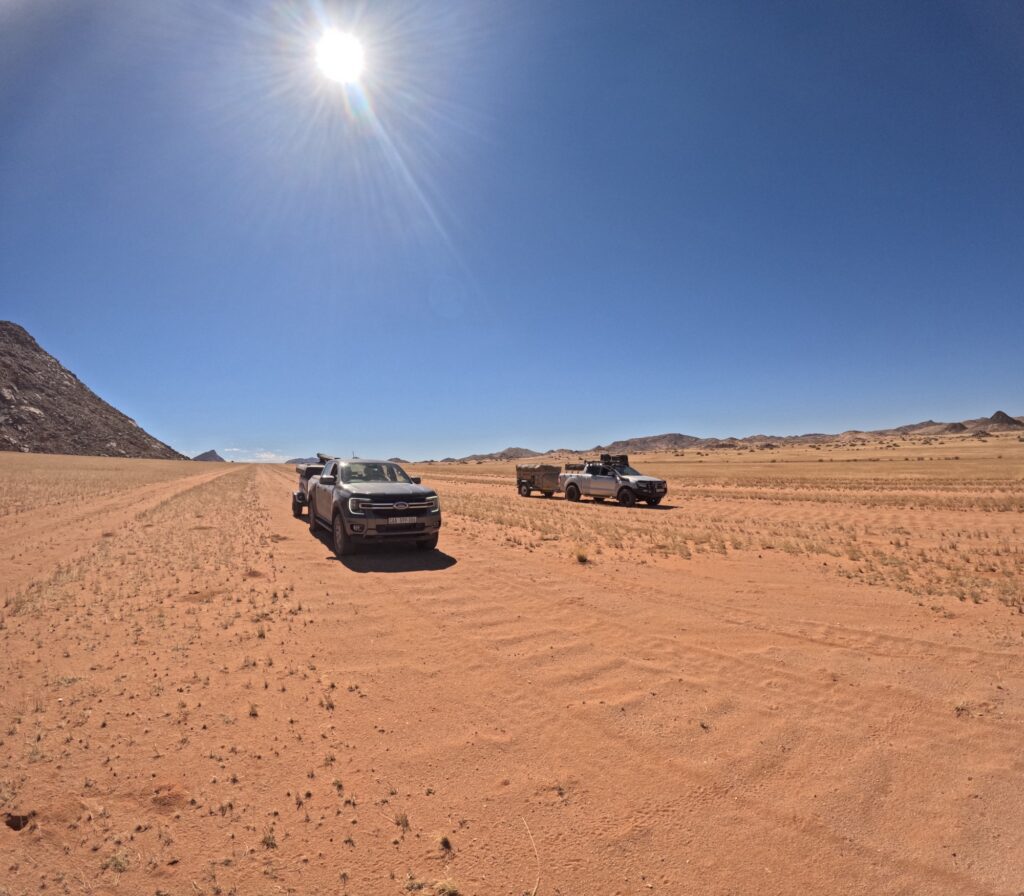
The following morning, the Namakwa Echo Trail taught us that the "schedule" was officially dead. The dew revealed a stone-inflicted puncture—the R355’s parting gift. Repairing a tire in a "lokasie" backyard based on whack local directions became our morning exercise.
This delay highlighted our primary navigation strategy: The Human GPS. While we had Garmins and Tracks4Africa to get us in the ballpark areas, we relied heavily on the locals. Their directions were a beautiful, confusing dialect of desert-speak. Is the turn 5km away or 50km? You only find out when you get there. We wanted to be out here, truly exposed to the reality of the trail, navigating by instinct and the word of those who call this dust home.
The repair cost us Charlie’s Pass, forcing us to sacrifice the transit for a night at Klein Pella. This became our first true camp of the trail. The trade-off was pure magic; we snaked through riverbeds of soft, deep sand, crawling at a snail’s pace just to drink in the sheer scale of the Northern Cape before the sun dipped.
The next day's push toward Raman’s Drift was where the Namakwa really began to bare its teeth. The 45-degree heat meant our tires were cooking. We snaked along the Orange River through a gauntlet of dusty gravel and moon-craters. Soft sand riverbeds narrowed the trail, giving the rigs several "bush kisses" on the paintwork.
Unusual high rains had maid the popular beach camp sites inaccessible. Melkhout Boom was a mess of rock beds—completely washed out and unusable. When we reached Raman's Drift, the only beach site was occupied, forcing us downstream into an impenetrable wall of bush. The tight maneuvers were a nightmare; Sergio had to reverse his massive trailer out of that thicket for what felt like a kilometer in the sweltering heat. Eventually, the beach cleared, and for Christmas, we had the banks of the Orange River all to ourselves under a kaleidoscope of stars.
We would have stayed longer, but the 45-degree heat was winning. Despite the solar setups, our electronics were failing and the fridges were struggling. We had to break camp and depart to save our Christmas feast—leg of lamb, prawns, and pork belly—heading toward the relief of AC power for the next leg.
Leaving the river behind, the section between Goodhouse and Vioolsdrift turned into a gauntlet of technical rock steps and wheel articulation. The NextGen’s electronic terrain management saw it scale the mountains with surgical precision, but on the descents, the stock ground clearance finally bit back. I left my plastic running boards as an offering to the 4x4 Gods. This was where Sergio’s "Battle Tank" truly came alive, its raised suspension gliding over the obstacles that were wounding my stock XLT.
Crossing Into The Namib
Crossing into Namibia at Vioolsdrift was a two-hour war of attrition against red tape and Foot and Mouth Disease inspectors. We surrendered our fridge contents (after we stored the most important stuff in our stomachs) and pushed through the heat to NamGate Guest House. There, the local hospitality was as A-grade as the Namibian meat we picked up; the team even helped re-attach the wounded Ranger's running boards while teaching us a few Nama words.
The transition to the hot springs of Ai-Ais felt like a fever dream. One minute you're white-knuckling a rock ledge, the next you're soaking in a pool while baboons methodically plot the robbery of your dignity and your snacks. We pushed north from the Fish River Canyon panoramas into the heart of the acacia bushveld. The wildlife doesn't wait for reserves here; Warthog, Giraffe, Oryx, Springbok, and Blesbok roam the roadside, appearing through the heat haze like ghosts of the desert.
We bypassed the C13—our Human GPS sources warned of flood damage—and tracked inland toward Sesriem. After seven hours of relentless dust, we hit the Sesriem Oasis campsite. That night, the desert came to us. Jackals circled the fire while a group of Oryx drifted through the camp to graze on the grass, their silhouettes stark against the starlight.
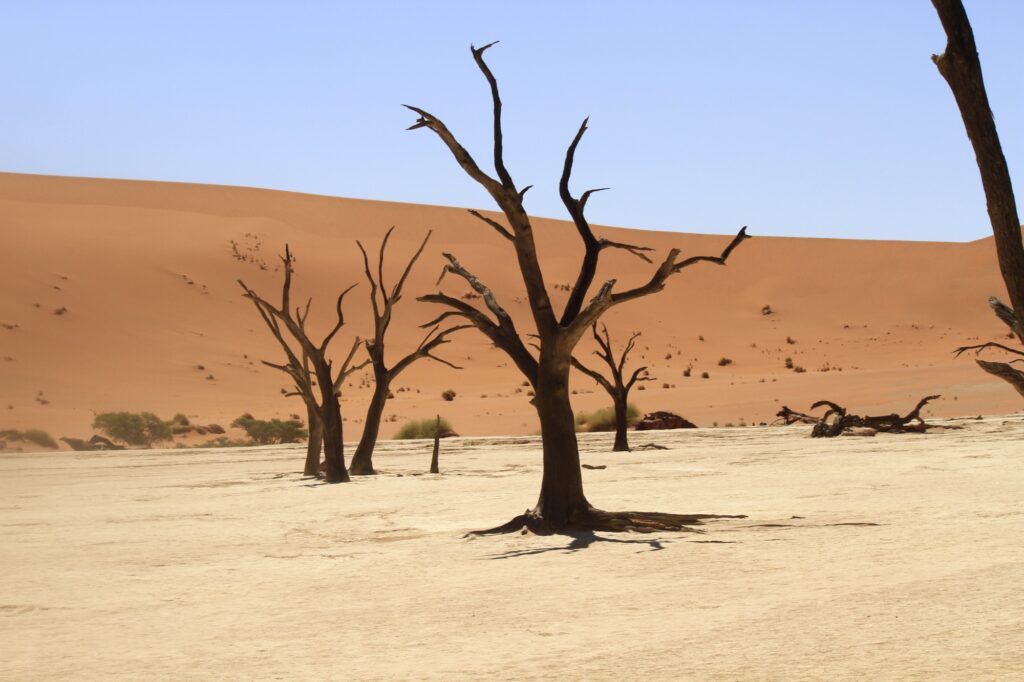
As if the wildlife wasn't enough, we spent the next morning exploring the deep cuts of the Sesriem Canyon before moving into the heart of the Sossusvlei Reserve. We made several dismal attempts at scaling some of the massive dunes in the park—losing the battle against the shifting sand—before making our way to my favorite place on earth: Deadvlei. It is a place of haunting, petrified beauty—dark acacia skeletons standing in a white clay pan, framed by dunes the color of rusted iron. By the end of this trek, the 40-degree heat had claimed its first casualties among the crew. We retreated, losing honorably to the scale of the landscape, and began the long trek toward Walvis Bay.
This final leg was a war of attrition. Punishment came in the form of heavy ruts and traffic that eventually kicked up a stone and shattered my windscreen. The Battle Tank struggled with overheating under the strain of the Conqueror trailer, while I found that holding exactly 95km/h smoothed out the ruts just enough to stay sane.
We finally made landfall in Walvis Bay, staying at the Lagoon Chalets for three nights of well-earned recovery. Walvis Bay and neighboring Swakopmund are an absolute blast. We tried to cram it all in, including a second outing into the dunes with buggies and quad bikes. Drifting through that sand on four wheels was the most fun I’ve had in years—and it was perfect practice for the "Main Event" at Sandwich Harbour.
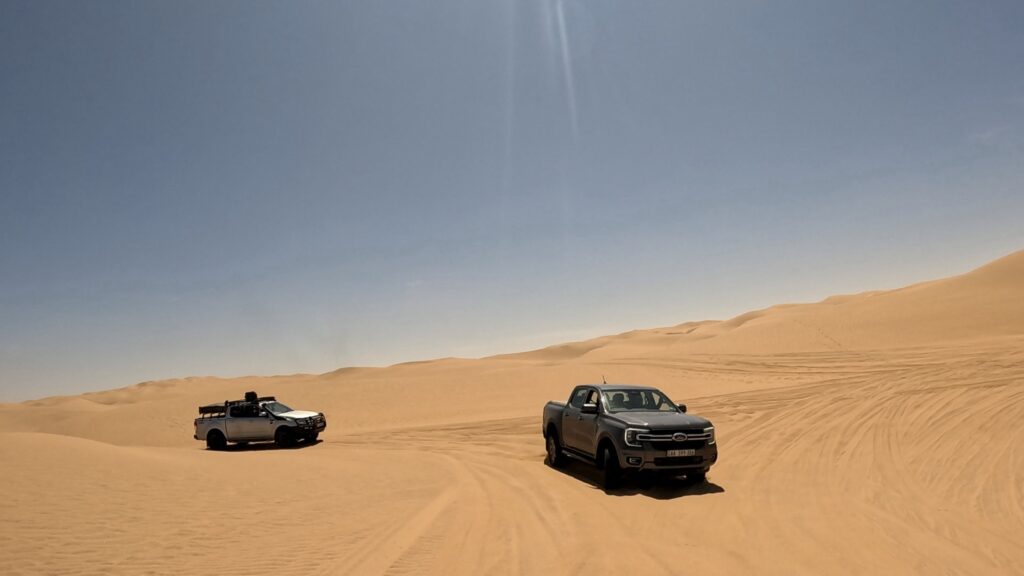
Taking our own rigs through Sandwich Harbour was the ultimate driving experience. Booked through Photo Adventures, it’s a self-drive tour that places you sandwiched between the Atlantic and the vertical wall of the Namib. At points, ocean tides was touching the wheels. Despite having a tiny 2.0L engine the NextGen scale massive dune faces with ease, even as the gearbox and sensor systems completely freaked as we pushed into the dunes. The battle tank was having a similar blast of a time, Sergio’s custom exhaust barked across the immense silence of the dunes as we stood vertically against our firewalls descending 100m high dunes.
In The End
Five thousand kilometers later, the conclusion is stark and unsanitized: Trailers are shit!!!! This "try-before-you-buy" experiment was a spectacular failure. They ruin your ride quality, kill your maneuverability, turn stone chips into a catastrophic event, and make you a slave to the terrain rather than a master of it.
But in the end Overlanding isn't just about the gear you have; it's about the insulation you're willing to shed for utterly rare experiences. We left parts of our cars in the dust, surrendered our snacks to baboons, and were humbled by the sheer indifference of the African landscape. But as we stood on the banks of the Orange River, or the dunes of Swakopmund, watching the Atlantic hit the Namib, the "trail tax" felt like a bargain. Africa doesn't care about your itinerary—she only cares that you showed up. Go get some of it on your tires.