
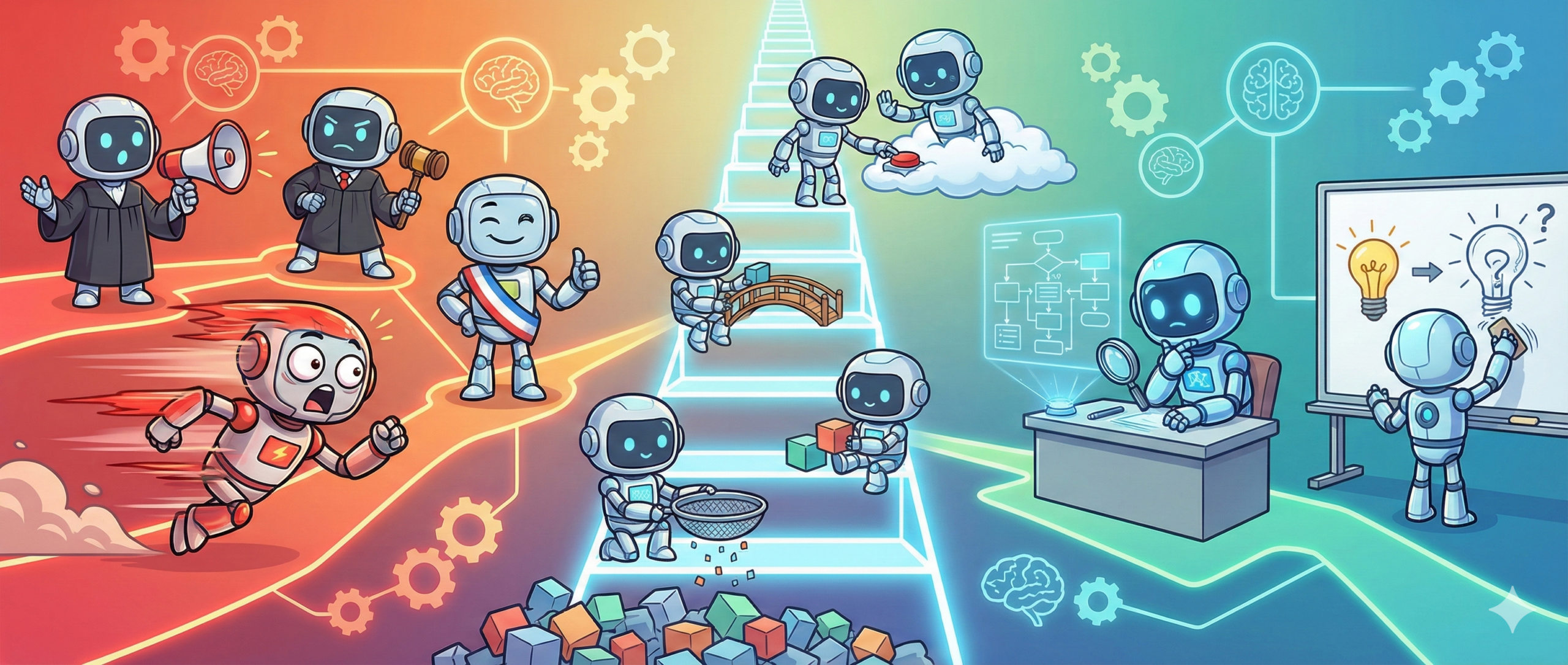

Since the beginning of my leadership journey—spanning more than a decade —I’ve been told that effective leadership is about asking questions. Every book says it: "Listen 80%, Talk 20%." But if I’m being honest? I never felt like I mastered it. I would ask open-ended questions, hoping to stumble upon an insight, but often I just felt useless. I felt like I was playing a character—the "Patient Leader"—while my brain was screaming the answers.This specific agony is what the villain Thanos famously called the "Curse of Knowledge." As I gained experience leading software engineering teams, I found it increasingly painful to hold back. When you see a team walking toward a cliff you’ve fallen off a dozen times, your instinct is to grab the wheel. The struggle wasn't about my ego; it was about the excruciating difficulty of balancing what I know with the patience required to let someone else discover it. When you know the answer, withholding it feels like negligence. It wasn't until I read Adam Grant’s Think Again—and exchanged emails with him regarding our specific organizational challenges —that the mechanics crystallized. I wasn't supposed to be a "knower" dispensing answers. I was supposed to be a "rethinker" facilitating discovery. Here is a summary of two books that provide the cognitive architecture we need to navigate this. They offer the tools to move us from "Unconscious Competence" (doing it right by accident) to "Conscious Competence" (doing it right on purpose).
The 2 Minds by Daniel Kahneman
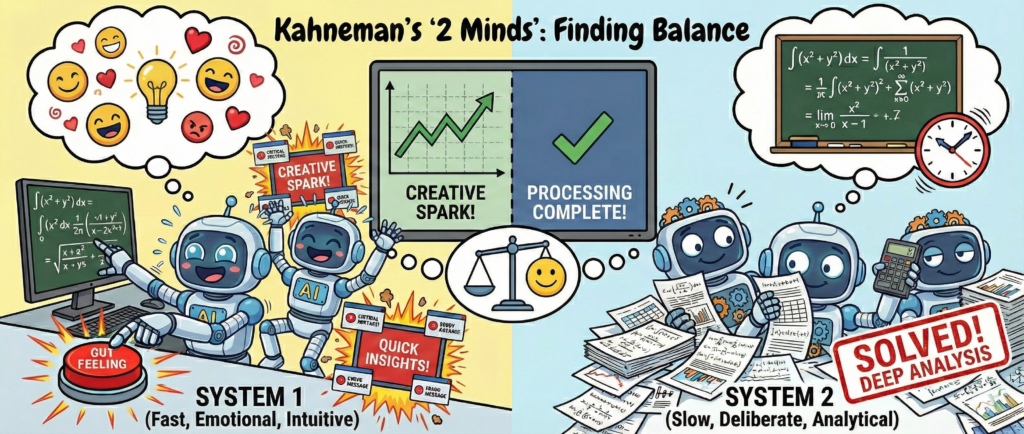
To understand why even the smartest engineering teams get stuck, we must look at the biology of the brain. Kahneman establishes that the brain seeks to conserve caloric energy by defaulting to two specific modes of operation:
- System 1: Fast, intuitive, emotional, and relies on pattern-matching.
- System 2: Slow, deliberate, analytical, and logical.
As Software and Machine Learning Engineers, we identify strongly with Spock, sometimes a little too strongly. We think of ourselves as logical beings, largely operating in what Kahneman calls System 2 (slow, deliberate, analytical).
But experience has taught me the exact opposite.
While we pride ourselves on logic, engineers are actually among the most emotional and creative beings I have ever had the pleasure of working with. We care deeply about our craft. We feel physical pain when we see bad code. We feel elation when a complex system finally hums. The danger isn't emotion itself; the danger is the Bias Blind Spot. We believe that because our code is logical, our thinking is automatically logical. But often, a sharper mind doesn't protect you from bias; it just gives you a better vocabulary to rationalize it. We need to accept that we are emotional beings. We cannot simply "turn off" System 1—nor should we want to, because that intuition is often where our creativity comes from. The goal isn't to suppress System 1. The goal is to train ourselves to recognize when it is speaking, so we can deliberately apply System 2 to moderate the output where needed.
Think Again By Adam Grant
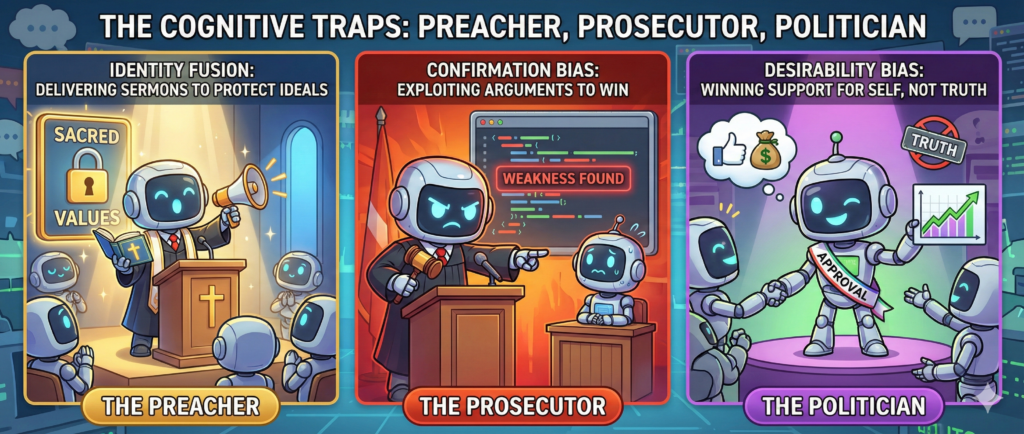
Once we accept that we are running on System 1 software, we need a toolkit to help System 2 intervene. Adam Grant identifies three distinct "cognitive modes" we slip into when our professional identities are challenged as a consequence of Kahneman unchecked System 1 operations.
- The Preacher (Identity Fusion): We enter this mode when our sacred values are threatened. We stop evaluating data and start delivering sermons to protect our ideals.
- The Prosecutor (Confirmation Bias): We listen to opposing arguments solely to identify weaknesses to exploit. In a Code Review, this looks like trying to "win" the review rather than improve the code.
- The Politician (Desirability Bias): Influence is a key part of our role; we must appeal to the disposition of our stakeholders to foster support. Here we've often trying to preserve our social capital, by saying what people want to here.
Grant argues we must think like Scientists. This doesn't mean just being analytical; it means actively searching for disconfirming evidence. While noting that it is indeed necessary to do this in your own capacity with techniques like counterfactual thinking, I found that it’s particularly important to support that with a strong Challenge Network. This is not as simple as "thinking critically," as it is near impossible to overcome our biases, values, and cultural filters. To achieve success in this, we need to build a Challenge Network. We all have a Support Network (people who encourage us). But to be Scientists, we need a group of people we trust to critique our work, not our worth.
This requires us to embrace a specific type of friction:
- Relationship Conflict (Destructive): This is personal tension, animosity, and clashes of personality or values.
- Task Conflict (Constructive): This is a clash of ideas. It is a heated debate about architecture, strategy, or implementation.
Grant points to the Wright Brothers as the ultimate example of this. They were famous for their screaming matches. To an outsider, it looked like toxic dysfunction. But in reality, they were brutal on the ideas while remaining committed to the partnership. They engaged in ferocious Task Conflict to solve the problem of flight.
Caveat: Even for the Wright Brothers, this was a razor-thin line. Grant laments how their sister threatened to leave the house if they would not stop fighting about the propeller system. They navigated no small amount of Relationship Conflict as well, proving that even the best "Scientists" struggle to keep the friction purely intellectual.
The Ladder of Inference
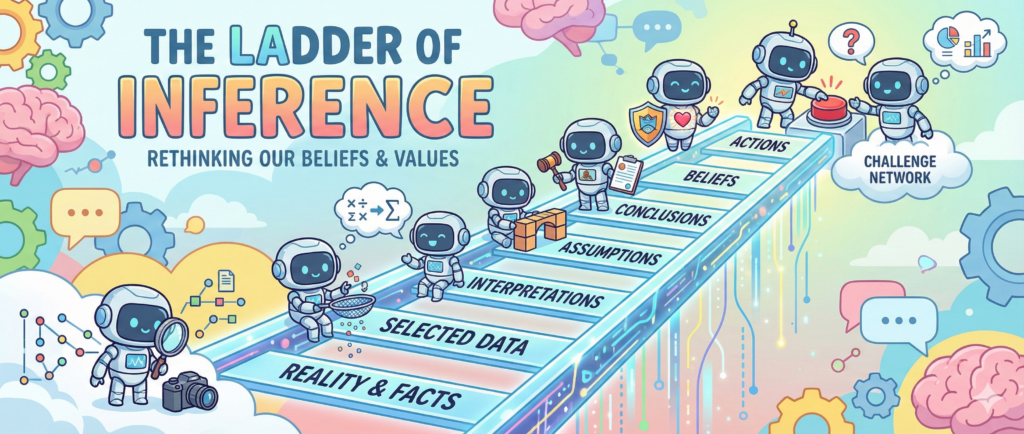
I was shocked to see that Grant actually replied to my email on the same day, and he was kind enough to remind me of the Ladder of Inference. The Ladder of Inference refers to the rapid mental steps we take to get from "what we see" to "what we do." We start with raw data, select only a portion of it, add our own cultural and emotional meaning, and make assumptions.
This leads to a critical realization: "The Map is Not the Territory."
- The Territory is objective reality (the raw data at the bottom of the ladder).
- The Map is your personal interpretation (the beliefs at the top of the ladder).
Rethinking requires us to acknowledge that our Map is just a flawed representation of reality, filtered through our biases. It is not just about our code, architecture, and strategy... It touches the most fundamental values that we hold true to our entire personal identity. Grant routinely touches on really loaded socio-economic issues like gender inequality and racism. He frequently brings in the experience of Daryl Davis, a Black musician who regularly engaged with KKK clan leaders, applying this rethinking framework to lead them to renounce their robes. I am reminded of my honours year at UCT GSB, where we were discussing a hypothetical mine in Africa. The proposition was that in exchange for mining rights, we would build roads, hospitals and schools, but upon excavation, we discovered that the mine was on an ancient burial site. My utilitarian worldview was obvious to me: "Build the mine. Surely the needs of the current community outweigh those of the dead." I asked our ethics lecturer, Prof Ethel Williams, if the point was for me to exercise stepping back from my absolutist perspective in favor of the cultural views of the community. Upon hearing my view, I recall the shame I felt when my Zulu classmates echoed across the lecture hall that I "can't say or do that.", I had triggered a deep and immediate rejection of my entire materialistic view, disturbing the resting place of their ancestors was just inconceivable . To this day, I try to justify that I was just trying to say my thinking was wrong, but in that moment, I felt like the biggest bigot on the planet. I have seen the tendency to confuse our Map (our perspective) with the Territory (the objectuve truth), assuming that our specific cultural lenses on respect, religion, and work ethic are objective reality.. Grant reminded me that this rethinking approach should be applied to underlying values as much as it should be to our way of thinking. We would be wise to allow others to critique our underlying values—our Ladder of Inference—as my classmates did for me on that day.
The Takeaway
This is a muscle that we can engage on demand. But it requires no small amount of practice. Even after years of doing this, it still hasn't quite clicked for me—and I hope it never will. I believe that it’s this very discomfort that places us in those cycles of rethinking. Grant outlines that a healthy amount of self-doubt and humility is critical to a healthy "Think Again" mindset. He goes as far as to say that Imposter Syndrome can be a strategic asset in this regard. He outlines the experience of Halla Tómasdóttir, a presidential candidate for Iceland after the 2008 crash. Instead of letting the fear paralyze her, she used it to motivate herself to prepare harder and listen more, ultimately performing exceptionally well despite starting as an underdog. I highly recommend reading these two books as a blueprint for fostering a healthy culture of learning and discourse that I’ve seen truly drive a team forward. I’m fortunate enough to work with people who just seem naturally talented at doing this. But as stated in the opening of this article, our goals should always be to move from the state of Unconscious Competence to one of Conscious Competence, where we can actively engage the muscles we need to not only achieve our goals but continue in the never-ending pursuit of self-discovery.
Comments are closed!