
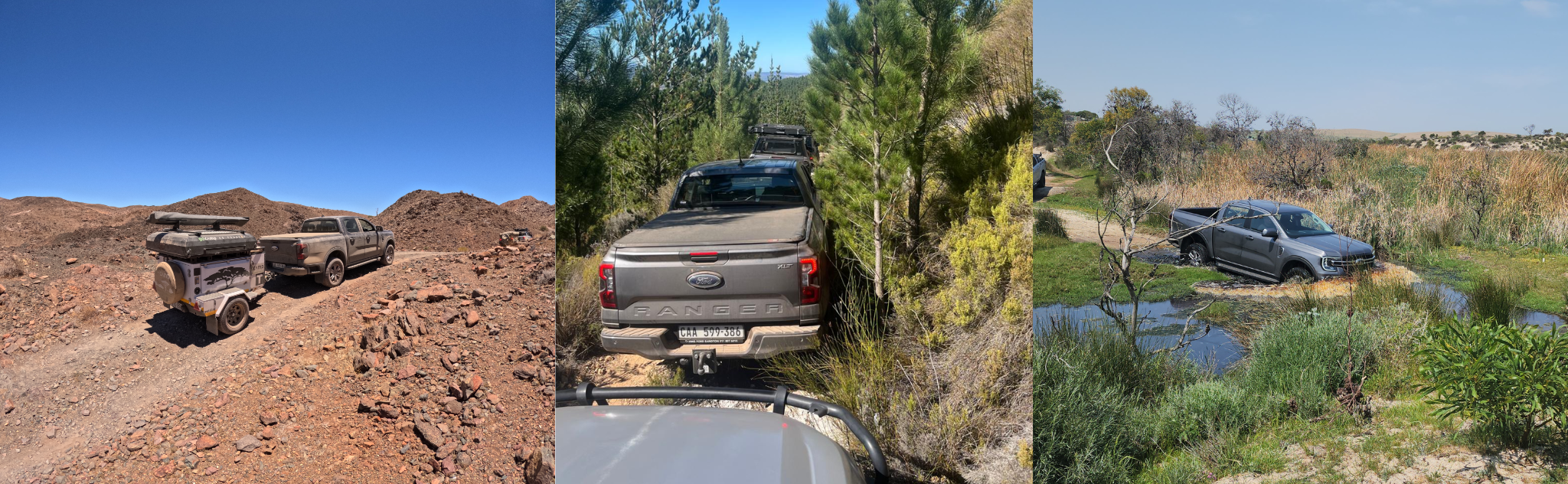

I’ve had this bakkie for a year now, having bought it in September 2024. New car anxiety starts the moment you try to wrap your head around Ford’s trim levels and option packs—you almost need a PhD to figure out what you’re buying. I ended up with the 2L SiT XLT AT/DC Pack 3, but sifting through the mountain of tech bundles and engine setups leaves you feeling like you’re settling for the "middle child" of the range, constantly second-guessing if you should have just bitten the bullet on an extra turbo, more ground clearance, and adaptive cruise control.
After a year of driving it in almost every condition imaginable—deserts, trails, cities, and long hauls—that anxiety has disappeared. Twelve months on the ground have proven that this Ranger isn't about compromise; instead, it’s a bakkie built to work well in every situation. I’ve put it through the wringer—from the busy streets of the Cape Town CBD to the bone-rattling corrugation of the R355, and across the border into the vast dust of Namibia.
What follows is a view of how the XLT actually handles across those worlds. You’ll notice a few quirks in each section—these aren't deal-breakers that compromise the core of the car, but rather the technical realities of a high-involvement machine. While no car can be all things to all men, I wager this one gets damn close.
The Trail: Is it any good offroad?
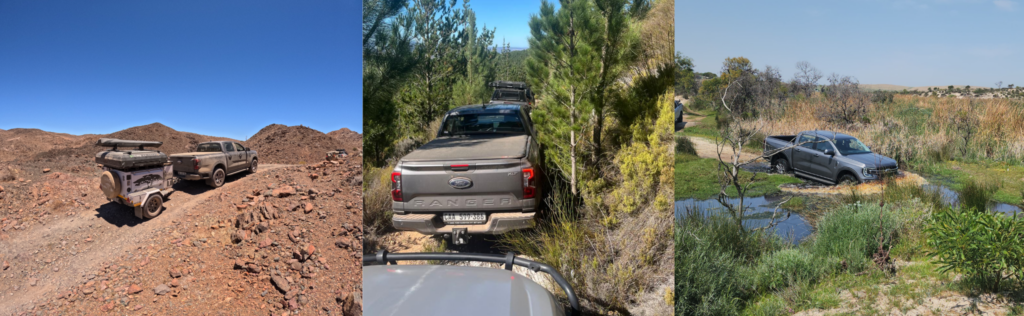
The Good: The Hill Descent Control in the Next-Gen is Ford's party piece. Having done Matroosberg Peak in my previous Ford, I remember that being where the old Hill Descent most failed me; slipping and sliding down the trail always had me switching back to low range and engine braking. This new system is more capable—it uses pitch and yaw sensors to anticipate the track, making technical descents smooth as butter. It works best in low range, though; in 4H, the hill descent feels a bit out of control coming down Grabouw.
Where other cars are slipping and kicking up earth, the XLT just crawls. On the "Die Hel" section between Goodhouse and Vioolsdrif, the bakkie climbed through technical rocky sections as if they weren't even there. The snub nose of the car provides a great approach angle, which I really appreciated during axle-twisters in Grabouw. This is also where those Continental tires proved their worth; even when they got hot on the Namakwa tracks at 1.5 bar, they survived the heat and sharp stones without a single failure. The truck stays planted.
The Quirks: While the approach angle is solid, the ramp-over and departure angles are not great. This is exactly where the plastic side steps finally decided to give up the ghost. On the rocks, the Ranger can feel a bit like a long-wheelbase limo, and I’ve already sacrificed both steps to "medium-spicy" obstacles. While I still sometimes prefer the old-school manual approach, this tech feels like something I can trust while not taking away from the experience of conquering a trail.
Sand Driving: Does it make a good Dune Buggie?
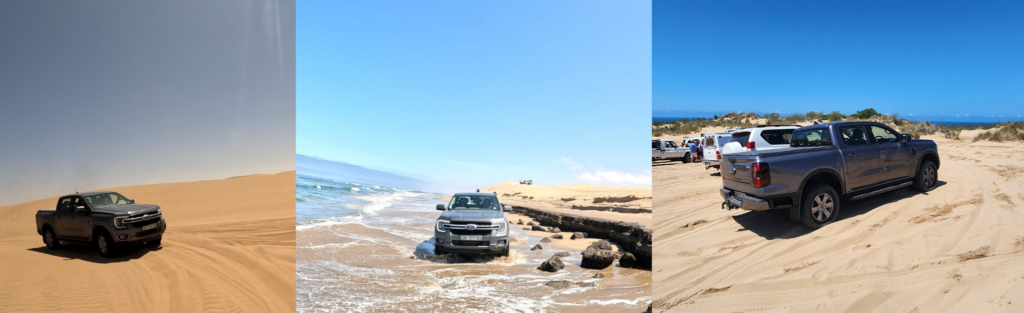
The Good: The car handles sand like a champ. Despite the electronic panic, the car’s brain usually figures it out and pulls you through the climb. Dropping the tires to between 0.8 and 1.2 bar depending on the sand will see you through most situations; I have yet to get it stuck. The electronic steering and suspension work well here, soaking up the sway like a luxury yacht in a light swell rather than throwing you around the cabin.
I remember hitting the Mossel Bay dunes with a group of Land Cruisers. They had a good laugh at my "shiny" car, telling me it looked "too pretty to get dirty"—until they were on their 8th attempt to climb a dune that was essentially a speed bump to the Next-Gen. I eventually just wiped past the Cruisers while their drivers were still reconsidering their life choices. Similarly, driving through that last stretch to Deadvlei in the Ranger feels like a Sunday drive.
The Quirks: The challenge in heavy sand is that the gearbox can be a bit "dim-witted," hunting for gears on a steep climb like a confused hiker. When the wheels slip, the TCS and ESC systems can freak out and switch everything off—like BLIS and Collision Detection—sending your dash into a digital meltdown. It's more prevalent in the big dunes than on flatter trails. Locking it in 2nd usually fixes the "stupid," but the tiny manual shift buttons on the lever are a mission to use compared to the old "push-pull" sport shifter. It’s a high-involvement moment, but the truck eventually pulls through.
Gravel Roads: Will it break your back on the R355
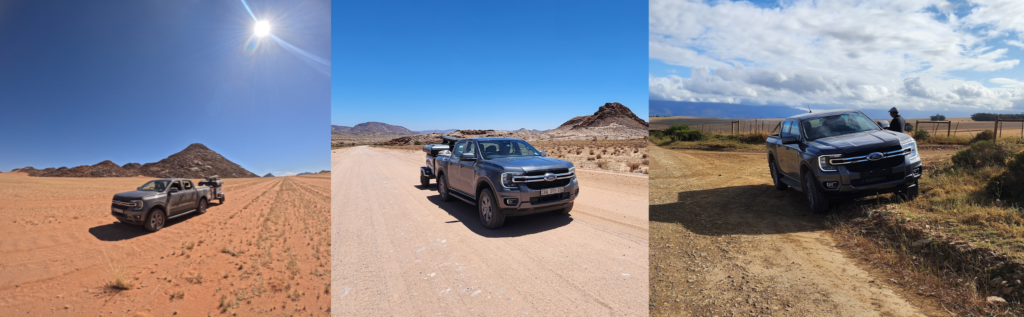
The Good: This is where the car comes alive. Whether it’s the back roads to Calvinia or the horizons of Namibia, the experience is all about bone-rattling gravel. On these corrugated stretches, the suspension handled the punishment while other vehicles in the convoy were rattled. The road between Solitaire and Walvis Bay should be a CIA torture site, but at 90km/h those corrugations mostly disappear, leaving you in a cabin that feels remarkably isolated from the chaos below. On gravel roads, I dropped the pressure to 1.8 bar, and the Continental CrossContact ATR tires were reliable.
Even towing a trailer wasn't enough to upset the suspension. The only truly useful drive mode on the long haul is Trailer Mode. Beyond adjusting the Blind Spot Information System (BLIS) to accommodate trailer length, it provides more engine braking and better gearing for the weight, acting like an anchor when you need to shed speed. That sense of confidence continues after the sun goes down; the lights are effective enough that the brights feel like they could be seen from the Andromeda Galaxy. Even the fog lamps do heavy lifting, providing enough lateral light to spot wildlife coming at you from the side—an experience I’ve had more than enough of.
The Quirks: While the tech helps, the standard cruise control is basic for a car this advanced. It’s a minor annoyance in a bakkie that is otherwise so tech-forward, but you learn to work around it. The real struggle on the long haul is the dust; the air filter takes such a beating on these roads that it effectively acts as a desert vacuum cleaner. It can visibly affect performance over a long trip, so carrying a spare or cleaning it regularly is a necessity rather than a suggestion.
City Life: Will it empy your wallet?
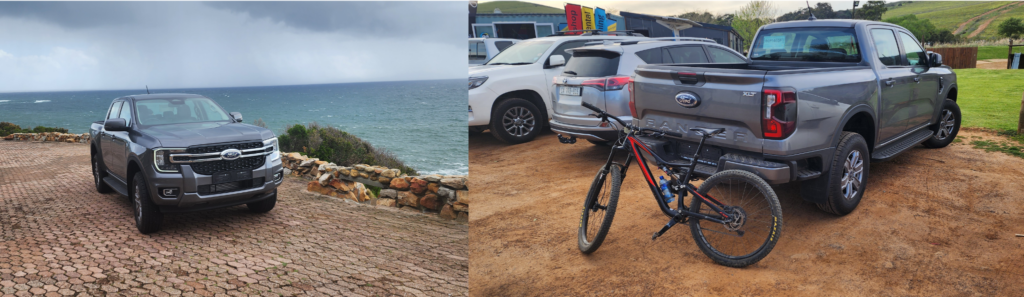
The Good: Daily life in the Cape Town CBD is surprisingly good despite the thing being the size of an Abraham’s tank. Fuel consumption is more like a Polo, though; I’m getting a solid 700km per tank in the city, and on the long roads across the Western Cape, that jumps to well over 800km. The infotainment system is a functional setup—the two screens provide a clear view, and the driver dash is highly customizable. Wireless Android Auto is convenient; getting into the car and having everything connect automatically is like having a digital butler greet you at the door.
The Ranger has the hips of a hippo, courtesy of Ford trying to "Americanize" the bakkie. Park assist is a must-have. Trying to keep it between the lines in the Virgin Active Foreshore parking lot would make your sphincter work overtime if it were not for the parking system. Thankfully, the wide-angle rear cam and Cross Traffic Alert make squeezing into tiny spots easier. Keyless entry is also a massive help when your hands are full, and remote start is fun if you want to freak the car guards out! Doing it from the phone is a bit gimmicky. I would have preferred the key, but using the phone to lock the car when you're not sure if you had is useful; mine works even when the car is under three levels of basement parking. I’ve also got the Collision Detection set to super-sensitive; Adderley Street, where people just walk across the road, seems to set it off most. It will slam on the anchors a good 5m–10m before mowing down brave pedestrians.
The Quirks: You have to expect a bit of a bounce when the bed is empty—it is the nature of the beast with any leaf-spring double cab. You’ll hear your tires chirping if you take a circle briskly, but the truck stays planted without that unsettling "Hilux sway." The tech has its moods, too. Wireless Android Auto disconnects quite a bit—it's bearable, but it happens. Using that big center screen while moving is like trying to text during an earthquake; your finger shakes with the road, and you really need a co-pilot to handle the tech, though the steering wheel buttons handle the basics.
The climate control is also a bit binary, acting more like a light switch than a thermostat—the AC is pretty much either full-on or full-off. The software can be finicky; I recently had the body control unit, collision, and blind spot sensors go haywire, and the car spent two days at Ford for software updates. As for the software "helpers," the Eco and Slippery drive modes don't add much value in the city, and the lane-keep assist often feels like a backseat driver tugging at the wheel.
The Verdict
So, should you have middle child syndrome about the Next-Gen XLT? The short answer is no.
The XLT is a capable tool that transitions from a city daily to a bush vehicle without much effort. It isn't perfect, but none of its flaws ruin the experience or make me wish I’d chosen something else. Especially When you consider that you can pick up a brand new 2026 XLT for around R650,000. Especially when compared to the R980,000+ price tag of a 2 litre Wildtrak, or the Hilux Raider at 6 to R700,000 with its cruise control nob from 2007 and Aircon dials from a washing machine —the value is undeniable. Used you can find low-mileage cars fetching R580,000, and even those that have just ticked over the 100,000km mark are holding strong at R490,000 for 2023 models. It proves that you no longer have to choose between a "smart" car and a "tough" bakkie; in the XLT, you get a world-class all-rounder that handles the dunes as well as it handles the mall run—all without needing the budget of a Wildtrak. And in the end, when I went to Namibia with my Hilux V6, I drove back to SA in limp-home mode with a stuffed-up fuel pump; in the Next-Gen, I came home cruising down the N7 with a trailer in tow. 'Nuff said.