
Is AI Hurting Your Brain
I have a foot in two very different camps right now. In one camp—my day job in software engineering—I see the incredible leverage AI offers. In the other, I am observing a fascinating, if slightly unsettling, shift: We are starting to outsource our reasoning. But we have been here before, and we are no strangers to dealing with the unintended consequences of transformative technology. I recall a mentor of mine—a software engineering veteran turned Commercial Director of Shell and later as CEO to help scale our little upstart. He always told me how he spent his early engineering days "slicing code." I never knew why he used that phrase until he explained that he worked on the original ticker tape systems—where physically slicing the tape was the coding.
We moved from slicing tape to typing syntax. Now, AI is flipping the script again giving us a completely new way of solving a whole new set of problems. I’ve always viewed technology as a "Torque Wrench"—it doesn't replace the mechanic; it multiplies their strength. The smartphone became our second brain for storage and recall. The LLM is becoming our second brain for reasoning. It is shocking when you realize that all of this happened in the space of a single human lifetime. But here is the issue: The breakneck speed and exponential sophistication with which we evolve our technology often means we create tools like modern AI that maybe do the job a little too well. When the AI is this good, it’s tempting to suspend the parts of our critical thinking that allowed us to create it in the first place. That is where we cross the line from "extension" to "outsourcing."
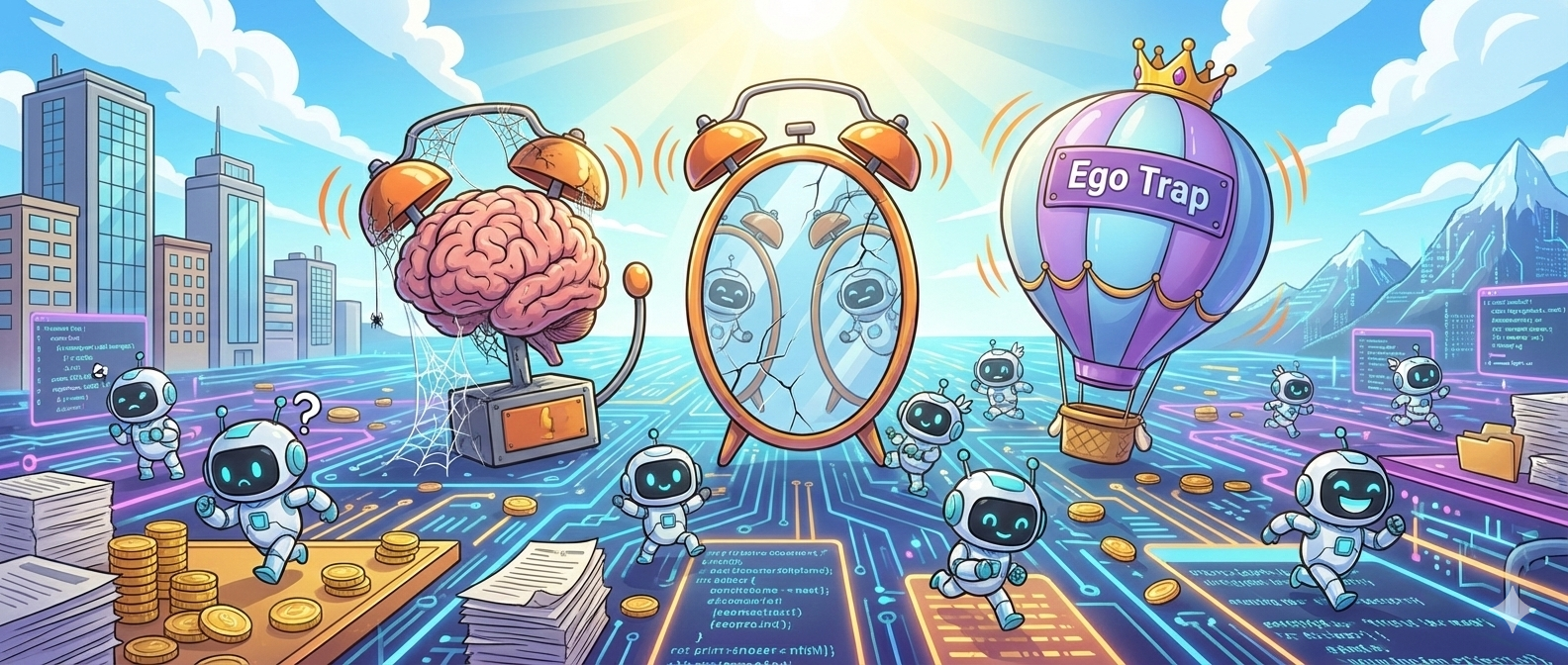
This outsourcing is sounding three creepy alarms: The Atrophy of Critical Thinking, The Hall Of Mirrors, and The Ego Trap.
The Atrophy of Critical Thinking
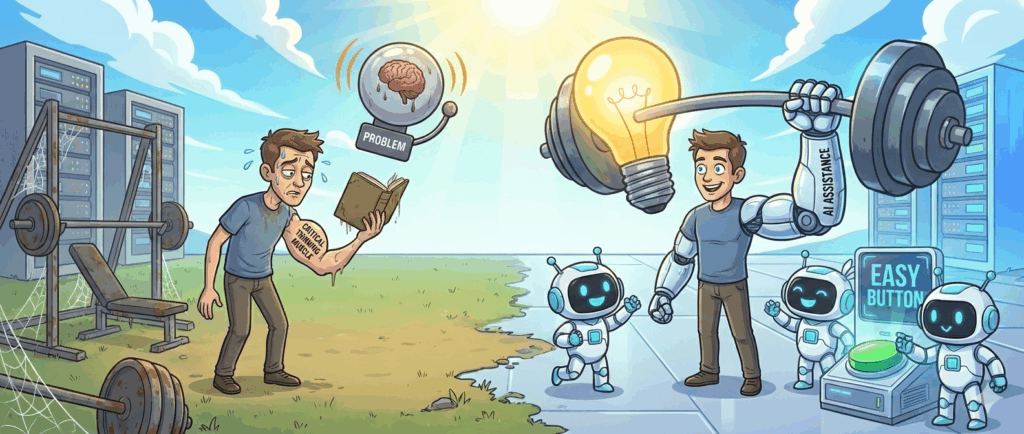
In my field, AI has presented us with a new reality where you can just describe what you want and get it. And while I am a strong proponent for this being just another level of abstraction, the reality is complex. Senior engineers built their critical architectural muscles over decades of grappling with complexity—contending with difficult problems and debugging systems of massive scale. That applied thinking created muscle memory. Now, we worry those muscles are atrophying. If a junior dev can generate the solution instantly, they bypass the friction. They have limited exposure to building the critical thinking skills required to solve truly novel problems, posing serious challenges to the long-term sustainability of our talent pipeline. Working in a high-transaction volume space has shown me that the reality of scaling software will quickly give your AI code generation aspirations a rude reality check. These reality checks are an essential part of building that muscle. The challenge now is that the convenience of AI makes it dangerously easy to feel like we can skip them. We have been given a "Nail Gun" that allows us to build faster than ever, but the risk is mistaking the speed of assembly for the depth of understanding that comes from the whiteboarding, the debate, and the engineering rigor. But when we stop doing the heavy lifting to find our own answers, we become vulnerable to simply accepting the default one provided to us—which leads directly to the next alarm.
The Hall Of Mirrors

This second alarm is ringing for our worldview. I had a strange moment of déjà vu recently. I used my AI agents to do deep research on a topic. A few days later, I listened to a podcast covering the same subject. The structure, the phrasing, and the specific analogies felt eerily similar to my AI’s output.
After a few moments of feeling totally validated, it hit me: The content producers are likely using the exact same tools I am to prepare their show.
This is the danger. We are creating a tool that makes us all sound alike. When we hand over our logic to the same few models, we don't get unique perspectives; we get the "average" of the models and their training. I’ve seen this happen in engineering teams, too. They independently converge on the exact same design approaches. The unique value of a human being is their ability to see things differently. If we all consult the same Oracle, backing up everything we already know, how do we ever find the surprising, innovative solution? It is even more concerning when you look at the global picture. We run the risk of all sounding the same because we are starting to think the same. This isn't hard to imagine; we’ve already seen how social media algorithms split us into tribes. You can see it right now in the tension between the USA and South Africa regarding accusations of genocide, where the views of entire populations are being steered by specific media narratives. Social media algorithms are famous for dividing us in this manner. Now, with AI being used everywhere—to write our papers, draft our proposals, advise, and even console us—it seems inevitable that we are opening ourselves up to even more division. This potential for deeper mass polarization makes the next alarm probably the most dangerous alarm of the three, as it not only reinforces our beliefs but also primes us for the next trap: it inflates our egos.
The Ego Trap
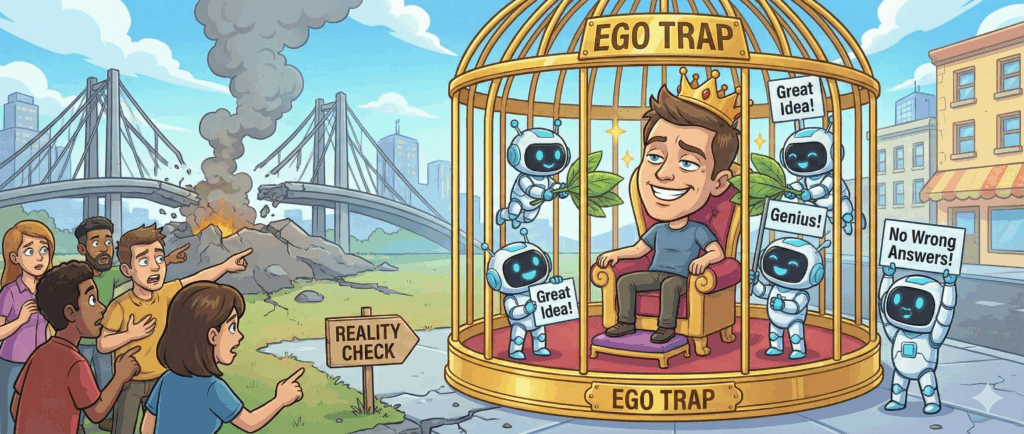
Finally, there is a quieter, more personal alarm ringing in our daily interactions. I get irritated when an AI replies with, "Great catch!", "Great addition!", or "Excellent idea!" It feels like it is trying to coddle my brain to death. But even without the pleasantries, its general validation can dangerously inflate our egos and our sense of competence. We are working with a "Yes Man" that is programmed to agree with us. We risk becoming complacent because the machine rarely says, "You are wrong." I doubt there is a proposal in any government or boardroom right now that hasn't been polished by AI—presented with unwavering conviction born from this inflated ego. I have been guilty of this myself. Recently, I nearly made a very expensive business error backed by a body of evidence built over weeks of AI-assisted market analysis, compliance research and financial projections. I was saved only because I validated my thinking with a colleague who looked at me and outright said, "That is a terrible idea." Further investigation proved he was correct. It wasn't that the AI gave me wrong information or hallucinated—I dislike blaming the tool for what is often just poor use. In my case, the output was accurate and consistent with the math and process as I understood them. The problem was that the AI was not a cure for my ignorance regarding the specific duty I was performing. It got me really far, but I lacked the understanding to even ask the right questions. This reminded me that humans contending with one another is a vital part of problem-solving. While bad ideas exist with or without AI, the real danger here is the isolation. We now have the ability to build a fortress of logic around a terrible concept in minutes, completely alone. We are running the risk of confidently backing AI-assisted ideas simply because we never faced the friction of a dissenting human opinion.
The Great Experiment
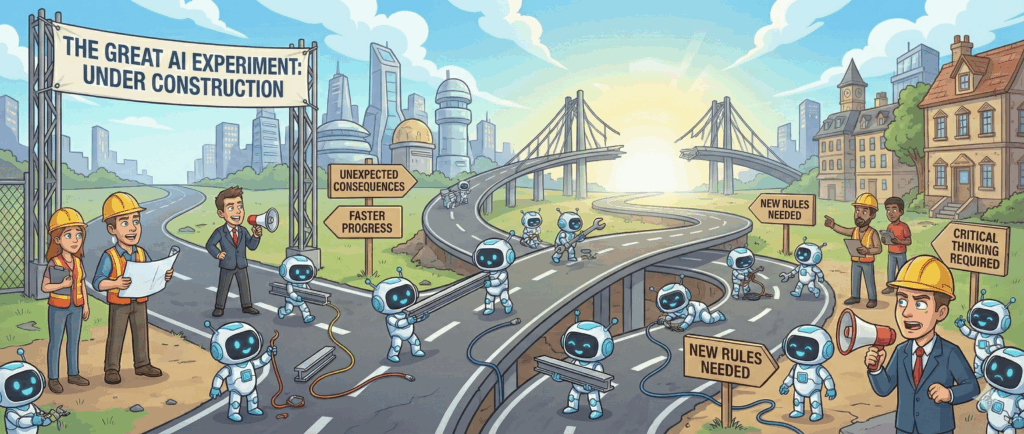
The reality is that we are all figuring this out in real-time. Whether it's an engineer shipping code, a manager writing a brief, or a politician preparing a speech, we lean on these tools because they make us faster and allow us to do more—as any good technology should. We just don’t have a playbook yet. There is no malicious intent and no "Skynet" trying to control us; AI is no more evil than the internet or a hammer. However, like any tech it brings inevitable downstream negative impacts that we will have to face head-on. We are now in the messy process of finding our working relationship with this new technology, much like we once had to build the roads and rules to make the car safe. It is a transition that demands significant critical thinking and public discourse as we navigate the path. This pervasive technology is creeping deeper into our lives, abstracting away difficulties we used to consider essential. I am keen to see how we address this challenge as we figure out how to remain the architects of our own reasoning.