

AI Bubble or Fuel for the Coming Transformation
Let’s come straight out the gates: We are likely in an AI bubble. I’m no financial expert. But I reckon the losses from it popping are an inevitable part of progress. The companies that die off are unavoidable damage as we scale out one of the most important things we’ve ever invented. As an Engineering Leader driving AI implementation, I see the reality of this tech every day. Software companies are reporting upwards of 40% code generation for new stuff, and the market is heavily invested in building agents that handle real, heavy lifting. The question of value has been asked and answered. But let’s look at the situation without rose-tinted glasses. We are borrowing elements from the two biggest financial cluster-f*cks of recent decades. When the bill finally comes due, I’m sure skeptics will scream "I told you so!" and blame the technology. I'm not saying the bubble itself—or the bubble bursting—is good or necessary. I'm just saying it's an inevitable consequence of this type of innovation. It is something that, while unavoidable, is survivable and can still result in a flourishing new market. But I here attempt to unpack the indicators that in my opinion suggest we in a bubble, and what kind of bubble it is.
The Financing Playbook: Echoes of the Housing Crisis
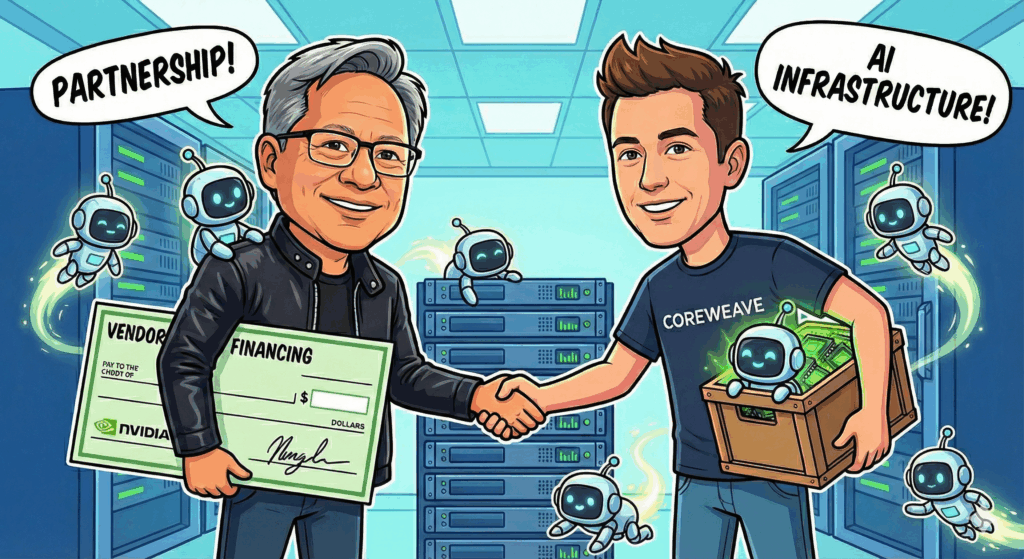
Everyone’s "Spidey sense" is tingling because of the fancy financing footwork we’re seeing with Nvidia and CoreWeave. It smells like the 2008 Housing Market Crisis. The parallel isn't just "bad loans"—it’s the pressure to deploy capital. In 2008, banks were awash with sketchy rating based liquidity and had to put it somewhere, leading them to fund "dog shit" mortgages because they ran out of prime borrowers. Today, Nvidia is in a mildly similar position without the fraud. Everyone is buying from them. This has created a revenue hockey stick so vertical it’s dizzying. Like the banks of old, they have so much cash sitting on the balance sheet that they simply have to put it to work. So, when they finance customers like CoreWeave to buy more chips, it isn't nefarious; it’s logical capital deployment. Vendor financing is a proven recipe. I’ve seen this playbook work firsthand. During the Fibre rollout in South Africa, we did the exact same thing. Our consumer connectivity market is supported by a hand full of Fibre Network Operators who was seeded from capital raised by their Internet Service Provider Partners. This approach is standard across industries—like Ford fronting cash to logistics companies to buy their trucks. The problem isn't the playbook; it's the collateral. Nvidia is backing these "loans" with their own Blackwell and H20 GPUs. CoreWeave uses that seed capital and their valuation to buy as much chips as they can get their hands on. Unlike properties that hold value for decades, these chips depreciate rapidly. And that’s not counting technical obsolescence as newer, powerful GPUs further drive down the cost of inference (the real cash cow outside of training). Bloomberg suggests a useful shelf life of six years. The BubbleMania rightly warns that If demand doesn't arrive before the clock runs out, the collateral Nvidia holds will be worthless. CoreWeave won't be able to make good on their leverage, and the trillions invested in Giga-watt data centers will be left gathering dust.
The Dot-Com Echo: The Delayed Fuse
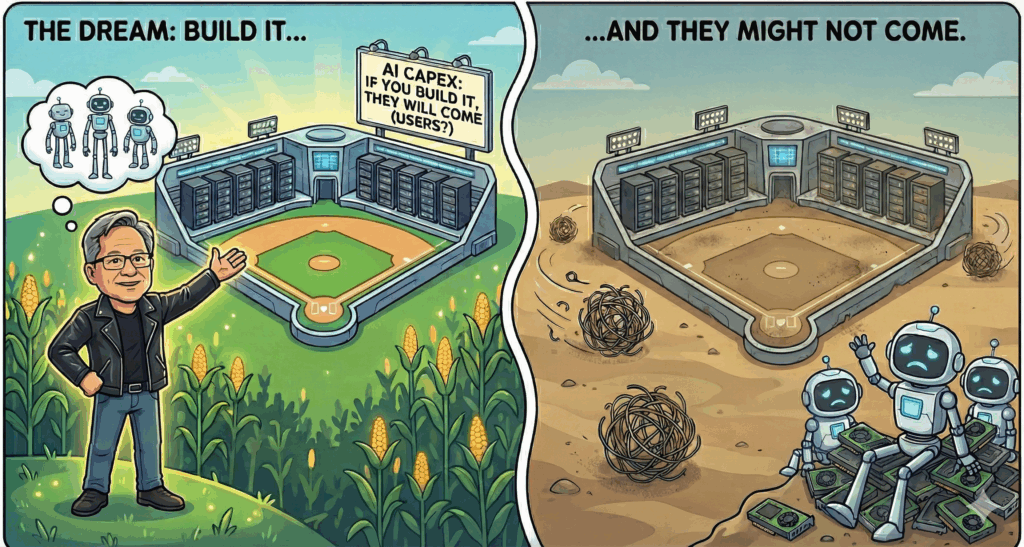
This brings us to the second parallel:Consider the Dot-Com crash, where they built out masses of pre-broadband network infrastructure under the assumption that the web would be the way the world works. While ultimately correct, their timing was off by a few years. The house of cards eventually came down, yet despite that, today we can’t imagine a life without the internet. We are seeing the same thing now, pouring trillions into infrastructure believing that if we build it, they will come. We are building data centers for a level of AI utility that doesn't exist yet. Mass adoption is lagging behind capital deployment. This lag is a problem because the current products paying for this infrastructure fall into two buckets: Too Niche (Enterprise) or Too Weak (Consumer) . AI/ML has been with us longer than most "Muggles" realize. It drives our Teslas and Waymos, and sits in our pockets. But this new class of LLM is a different monster. The complexity that makes "thinking models" powerful also makes them slow, limiting how we meaningfully use them.
Bucket 1: The Enterprise Play
The current upstarts (Lovable, Bolt, Cursor) focus largely on the developer niche and Code Generation. Lovable’s CEO has specifically cited "developer pet projects" as their wedge into enterprise sales which feels like "hope" as a strategy. The market is already cannibalistic, dominated by giants like Microsoft (GitHub Copilot/OpenAI) and Anthropic—which is effectively the best commercial AI money can buy. Even ignoring competition, the math doesn't add up. We sell these tools for ~$30 a pop. While inference & training costs continue to drop, enterprise subscriptions at that price point simply cannot service a trillion-dollar CapEx bill.
Bucket 2: The Consumer Play
For the rest of the world, the "AI App" landscape is a mixed bag. Google, in true monopoly fashion, is successfully experimenting with AI Search and AI Summaries. ChatGPT is often just a glorified spell checker for the average consumer. Agentic AI tools like Perplexity's Comet promise to shop for you, but the numbers don't work. OpenAI has ~10 million paying users. Netflix has nearly 300 million for a bench mark of a digital utility at scale, and we would need a host of these across varying industries. Furthermore, the "Agentic" dream is hitting a wall. Try using an agent for research on Property24 and you get blocked immediately. We are betting the future on an AI economy that the current web infrastructure actively fights against.
The Kill Zone: The Middle Layer
This product gap creates consequences. If a correction hits, it won’t be an extinction event. The giants—Nvidia, Microsoft, Google, OpenAI—have the war chests to eat the losses. They can wait five years.The slaughter will happen in the middle. Hype-fueled startups like Lovable, Bolt, and risk takers like CoreWeave may be in the kill zone. They are betting on a capped developer niche, don’t own the models, and don’t own the infrastructure. When funding dries up, they starve first.
The Optimistic View: New Markets
The optimistic view is that emerging tech creates emerging markets. While GPU-backed LLMs aren't fit for high-stakes environments—like your Tesla deciding who to kill in a split second, the puppy or the pole —the technology has massive applications in robotics solutions currently under development. We could still find a suitable activation of that supply.
The Verdict
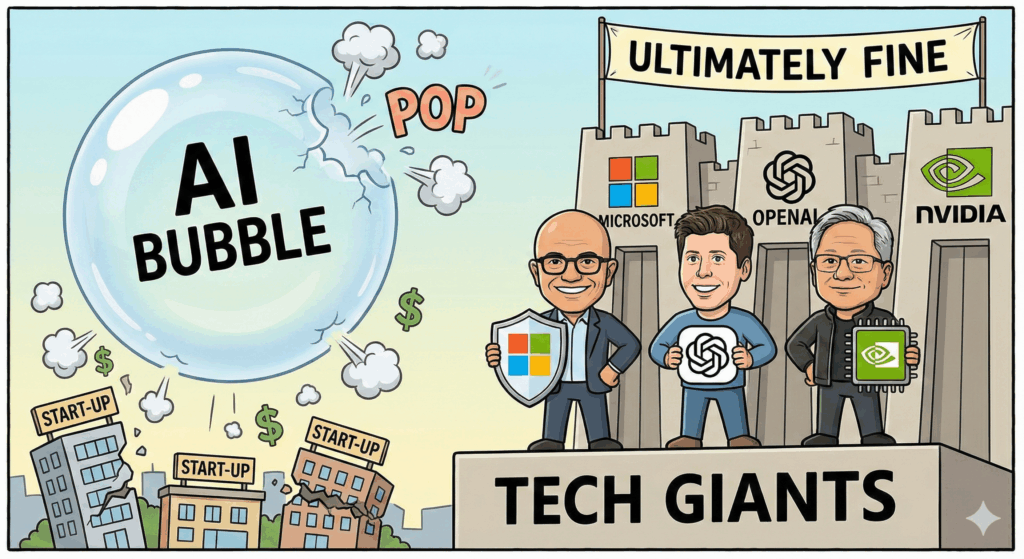
So yes, there is a bubble. But I’m not worried. The visionaries of the Dot-Com era were right; their timing was just off by half a decade.We are in the same cycle. The bubble may very well burst, the "middle" will be wiped out. But the infrastructure will remain, the models will improve, and the remaining builders will be here to continue the vital work of deploying AI. Just like the Dot-Com burst, a decade from now, we won't be able to remember a world without AI. Personally, I think commercially viable AI will only arrive latest 2030, which aligns with when we expect this capacity to become available. So maybe Jensen Huang is onto something—we have five years to figure out how to use that supply. This is what keeps me up at night: How do I meaningfully commercialize AI towards the success of our business? I believe the calls on capital deployment today are the right calls. They have given us the inflection point we need to make a success of this transformative tech.