
To Busy, No Stress here is an audio Summary of this article:
Bridging the AI Chasm: From "Hello World" to Enterprise Reality
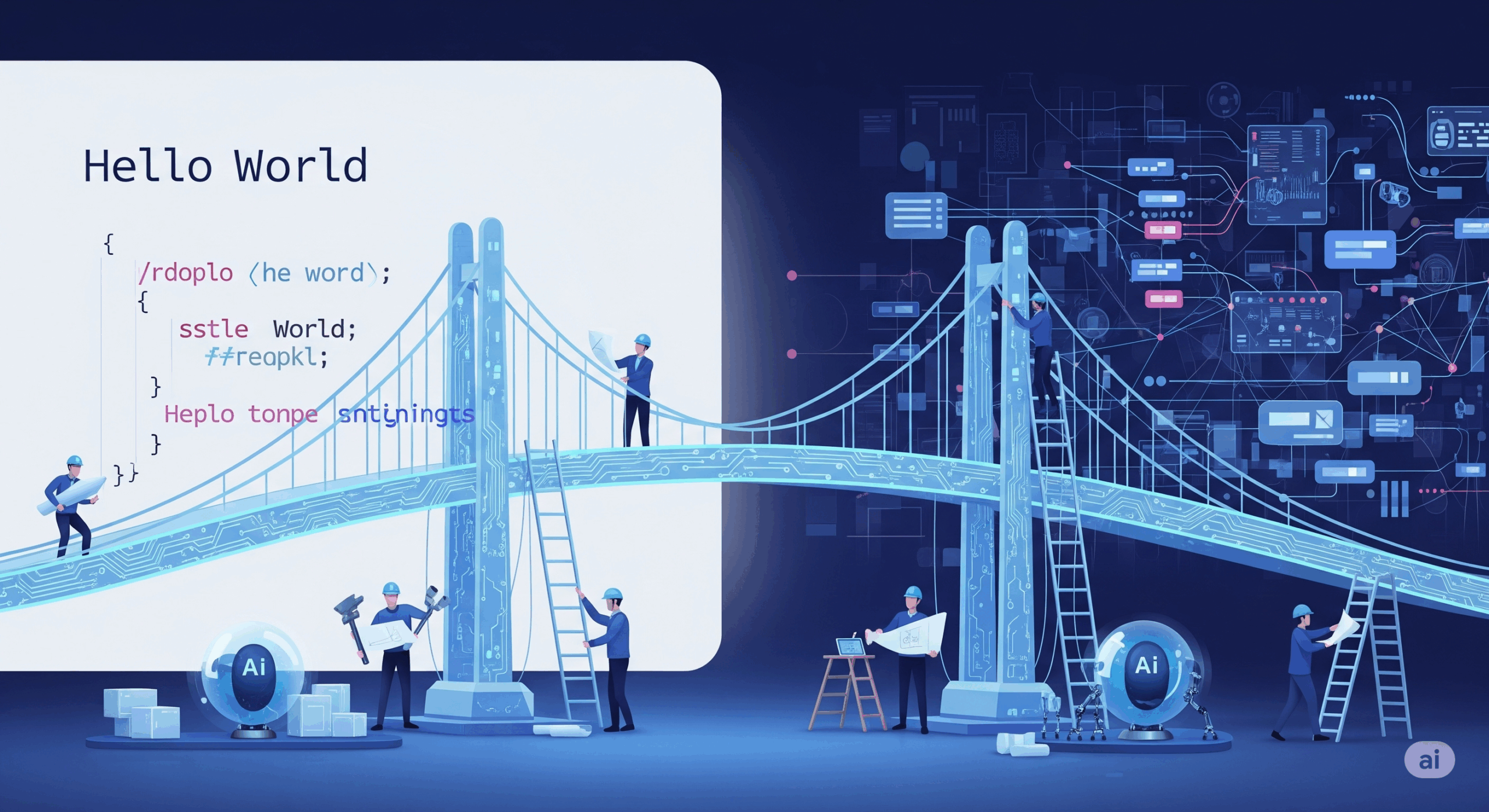
From my vantage point, having witnessed the evolution of software development firsthand, the narrative surrounding generative AI often conjures "hello world" applications and greenfield promises. This creates a significant chasm with the messy reality of integrating AI into "real companies." This disconnect fuels stakeholder mistrust and obscures the pragmatic path to unlocking AI’s profound potential within complex, existing systems.
Enterprise software isn't forged in a vacuum. These colossal, living entities, built over decades, are intricate tapestries of code serving millions. I often describe these codebases as "geological strata"—each layer reflecting its era's architectural styles: from early 2000s procedural code, to MVC patterns where the joy of ORMs meant never writing SQL, quickly evolving into microservices with myriad API styles (SOAP, XML-RPC, RESTful). This distributed approach, coupled with containerization, orchestration, and DevOps, added further complexity.
This relentless evolution meant no system could outpace change without racking up significant technical debt. This isn't lazy development; it's a function of time and continuous adaptation. Crucially, immense time is spent discovering and understanding the problem, a profoundly human, iterative process involving implicit business logic, hidden requirements, conflicting stakeholder needs, and anticipating edge cases. This reality stands in stark contrast to the dream of AI simply "generating" a complete solution from a simplistic prompt, highlighting why that notion is, for now, largely a myth.
Strategic Integration: Leveraging AI with the Strangler Fig Pattern and Model Context Protocols
So, how do we bridge this chasm? The answer isn't AI taking over; it's AI profoundly amplifying human engineering. We begin by acknowledging the inherent risks of generating code directly into a complex, live enterprise system – compliance, timelines, and that it legitimately might not work. The strategic approach is to pick something not on the critical path.
This is where the Strangler Fig pattern works exceptionally well as our strategic entry point. Imagine a vine slowly enveloping a tree; we identify a specific, isolated component within an existing distributed architecture. This component must be complex enough for a meaningful challenge but achievable, and, crucially, one that won't halt core teams if initial attempts fail. This strategic selection then opens the door for our technical solution: generative AI, combined with intelligent IDE agents like GitHub Copilot, to build a suitable replacement for that isolated component.
The game-changer enabling this is what we call Model Protocol Context (MCP). MCP is essentially a system that dynamically provides AI agents with the precise tooling and contextual information they need. This includes rich search capabilities, APIs for Retrieval Augmented Generation (RAG), or detailed API specification documents. By exposing our complex, internal company domain knowledge to AI through MCP, developers can prompt within their IDE to receive highly relevant, context-aware code suggestions. This directly addresses AI's limitations in understanding vast, implicit knowledge; MCP provides the necessary depth and nuance of our complex enterprise systems.
The Future of Enterprise Code: Amplifying Human Engineering with AI
This combined strategic and technical approach brings us closest to practical, general-purpose code generation in complex environments. It allows for a "rinse and repeat" cycle, continually refining agents and prompts for better outcomes, building confidence incrementally. It works because it doesn't diminish human reasoning. AI adeptly handles boilerplate and syntax, freeing engineers to concentrate on strategic, system-level thinking, grasping intricate domains, and implementing nuanced solutions. Developers still do what they do best: using code to effectively stitch complex systems and business domains together, using AI as an assistant.
This pragmatic application also directly addresses internal stakeholder mistrust. Moving past initial Proof-of-Concept demos is notoriously difficult, especially in high-volume environments, as they often fail to reflect real-world complexity, creating a negative feedback loop where stakeholders are reluctant to sponsor unless they see relevant results. To protect IP, I can't talk about details, but we've launched two successfully highly integrated AI initiatives with two more on the way in the last year and a half, and we're getting fast at it. This builds trust and demonstrates AI's genuine, invaluable potential beyond sensationalized "hello world" promises.
The aspiration for an AI agent that can build anything persists, but its practicality hinges on recognizing the vital role of human domain expertise and meticulously providing AI with the precise context it needs to operate within the intricate layers of real-world enterprise systems. This is where LLMs truly shine: as powerful force multipliers for human ingenuity in the pursuit of meaningful code generation in the enterprise.
Now, for a fun plot twist: many of my brilliant engineers strongly disagree with my view and are still relentlessly pursuing autonomous code generation from ideation to completion! They've even achieved some truly spectacular results that aim to address the above problems by broadly orchestrating a collection of coder, planner, and other agents to effectively solve real-world coding challenges. Honestly, I'm genuinely excited (and a little bit terrified) to see where this research takes us!